The 5 Ps of Successful Succession
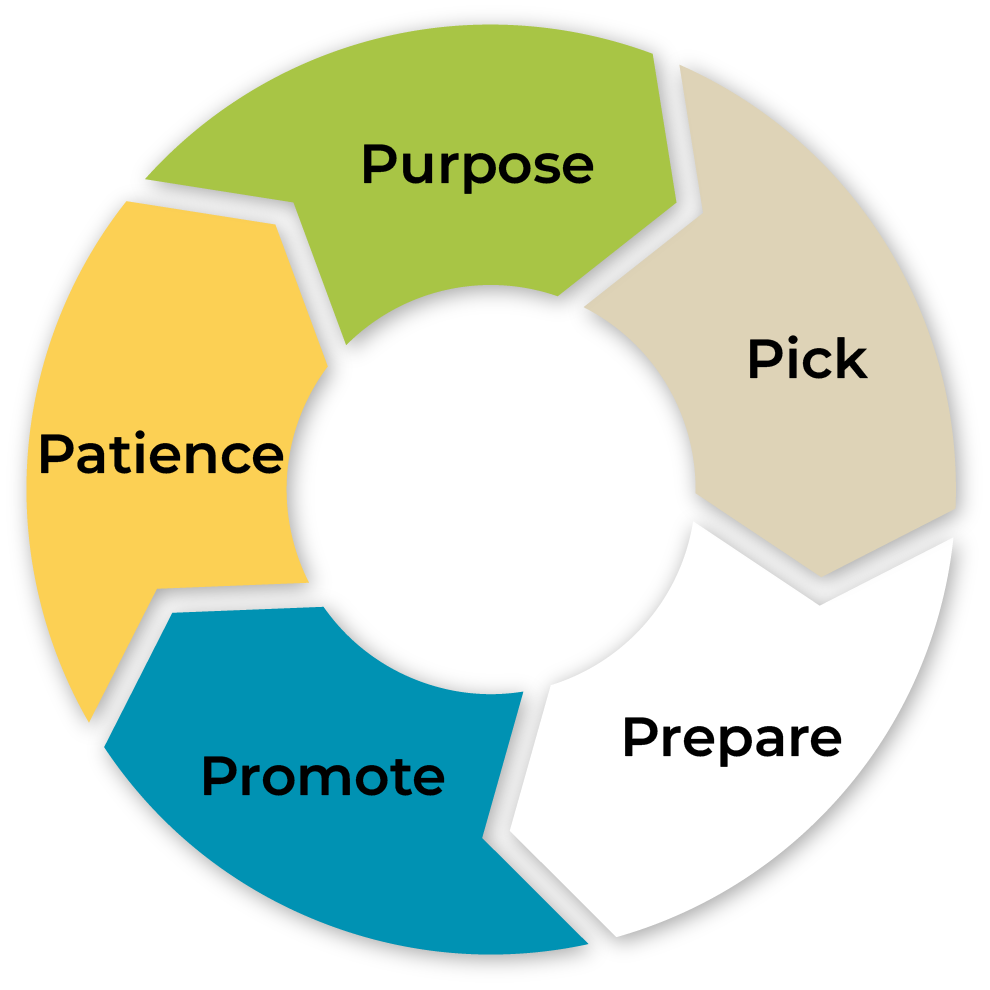
Purpose. Pick. Prepare. Promote. Patience. The human map for handing over the baton without dropping it - built from what actually worked when Stephen bought both family businesses from his own parents.
Five conversations that work as a loop, not a checklist. Most families are strong on two of them and silent on the rest.
The 5 Ps of Successful Succession
Purpose
Define the family's shared mission and vision.
Don't do something you love. Find something that annoys you about the world and spend your life fixing it. That is the test for a business purpose too. Before anyone decides who leads next, the family needs to agree on what the business is actually for: what it exists to fix, what it will not do, and what it should make possible for the generations coming after. Underneath the financial answer there is often a quieter one, because for the founder the business is also proof of a life's work. The next generation usually sees a business. The founder is living inside an identity. Agreeing a shared purpose is the reference point that makes every later decision easier, and if the purpose is no longer fit for purpose, succession gets harder until it is renewed.
Where families stall
Families start with ownership percentages or job titles and never settle why the business exists. Each generation holds a different answer and nobody compares them, so every later decision becomes a negotiation between individuals instead of a decision for the family.
The question to answer
What is this business for, and would the other generation give the same answer?
Pick
Identify the right NextGENtrepreneur leader.
Pick is the readiness question, asked honestly. It is not about birth order, seniority or who is loudest in the meeting. It is about who has the temperament, judgement and appetite to lead what the business is becoming, not what it was. Gut instinct is rarely enough, so use objective tools such as psychometric profiling and role-fit analysis to decide with evidence instead of emotion. There may be an heir apparent, several candidates, or nobody in the family who fits the brief. Each needs a different approach, and an outside leader is a legitimate answer.
Where families stall
The default answer is the eldest, the one already in the building, or the one who would be hurt most by a different answer. That is a decision about feelings dressed up as a decision about capability.
The question to answer
If this person were not family, would we still choose them for the role?
Prepare
Develop them properly, not just hand over a title.
Preparation is the work between deciding and handing over, and it needs to start earlier than anyone thinks. It combines coaching, mentoring, experience outside the family business and formal training, aimed at the real gaps rather than assumed ones. Prepare the person in front of you, not the person you hoped they would be. Osmosis is not preparation. This is how a NextGENtrepreneur earns the trust of staff, customers and their own parents instead of inheriting it on paper, and how they learn what they do not yet know before it becomes expensive.
Where families stall
The shortcut is the title first and the experience later. It puts an unprepared leader in front of long-serving staff who spot it immediately, and it teaches the NextGENtrepreneur that the family will not tell them the truth.
The question to answer
If the founder were suddenly unavailable, could the successor run this business for six months?
Promote
Hand over the baton with real clarity and public support.
Promotion is the moment the family says it out loud. Who is responsible for what, from when, and with what authority, stated to the family, the leadership team and the staff in the same breath. The outgoing generation then becomes the NextGENtrepreneur's loudest cheerleader. Disagree behind closed doors and support publicly. Challenging them in front of the team damages the credibility they are still building. When people see the founder backing the person in the seat, trust transfers and the organisation stops routing around the new leader.
Where families stall
Handovers that stay vague, happen quietly, or arrive with an invisible veto attached. The new leader is left guessing where their authority ends, and the outgoing leader wonders why they still feel in charge.
The question to answer
Are we saying this publicly, in writing, and with the outgoing generation visibly behind it?
Patience
It will go sideways. That's normal. Stay the course.
Patience is the P families underestimate most. A real transition usually takes three to seven years, because trust is passed on slowly and authority is earned over time. It will not go smoothly, and that is not failure. Think in milestones, not footsteps: keep the outgoing generation informed of the bigger picture without being involved in every small step. Give the next generation room to lead in their own way, not as a replica of yours. When things get messy, return to the purpose and begin the decisions again. Patience does not mean passive. It means treating succession as a process to navigate well, not something to get through.
Where families stall
The family treats the first mistake as proof the pick was wrong, the founder steps back in to fix it, and the transition stalls for years. Impatience turns a normal learning curve into a succession failure.
The question to answer
Do we have a plan, milestones and room for course correction, or is one of us just waiting for this to be over?
Using The Framework
It is a map, not a test.
Use it as an agenda
Put the five headings on the table at your next family meeting and let the family work out which one you are actually arguing about. Most succession fights are about one P, not all five.
Use it to find where you are stuck
Most families are strong on two or three and silent on the rest. The P nobody will talk about is usually the one holding the whole transition up.
Use it with both generations in the room
The framework works because it gives the founder and the NextGENtrepreneur the same language. It is harder to talk past each other when you are both answering the same question.
Come back to Purpose
When the transition gets messy, return to the first P. Anchoring in why the business exists is how families restart the decisions without restarting the argument.
Work backwards, not just forwards
Usually, when one P is causing trouble, it is because the one before it was never fully resolved. A family arguing about Promote has often never settled Pick. A NextGENtrepreneur who cannot get authority is usually a leader who was never properly Prepared. When something feels stuck, walk back through the five until you find the conversation nobody finished - that is the one to have.
Ready To Talk
Which P is your family avoiding?
A confidential, no-obligation conversation is the quickest way to find out - whether you are the NextGENtrepreneur or the current-generation leader.